03 · UX research · Concept prototype
Trust Check
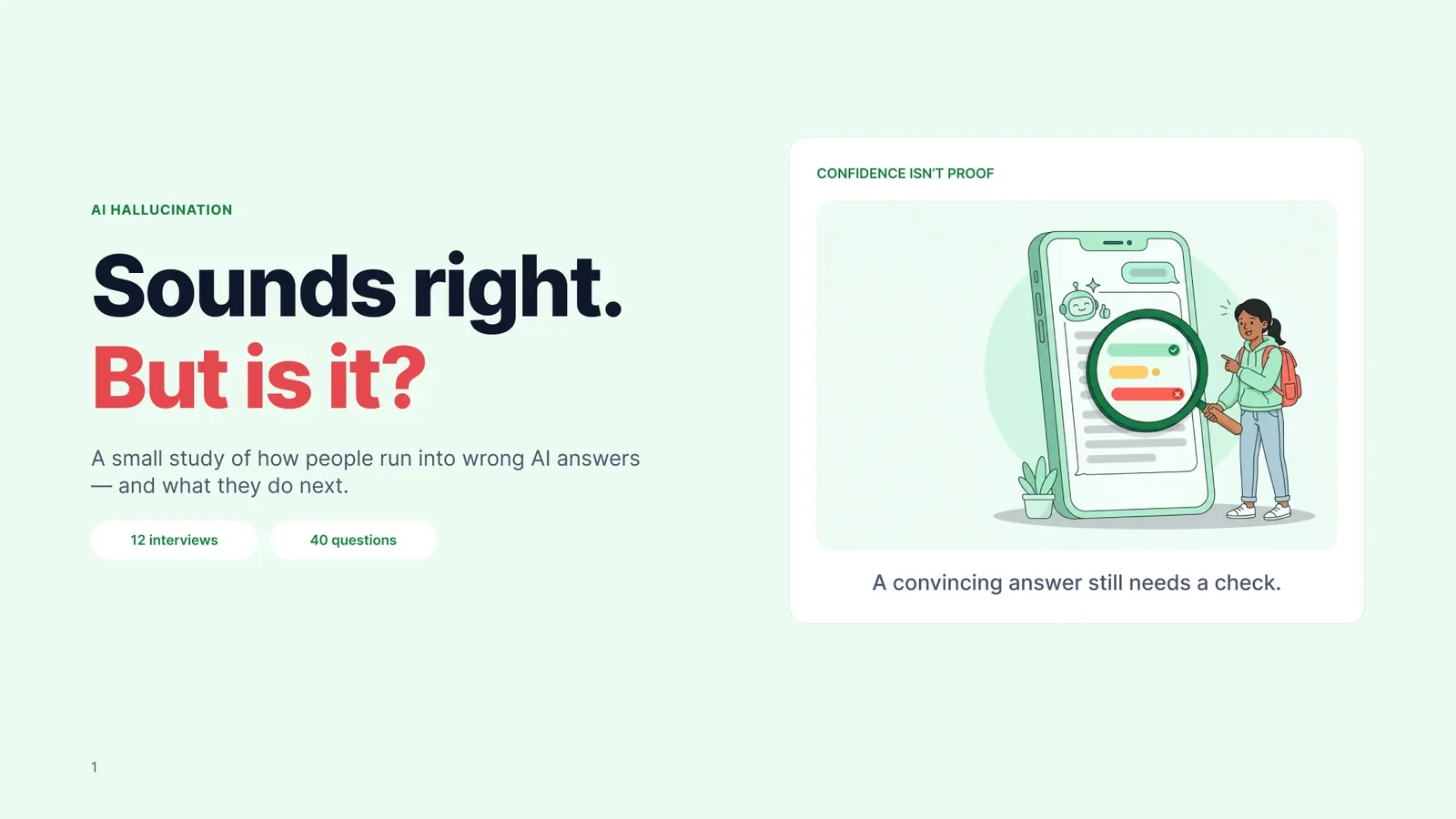
A study of why confident AI answers get believed, and a prototype that helps people check before they rely on one.
01
The prototype
The prototype works in three steps: write your prompt, improve it before sending, then get an answer with linked sources. We chose to act before the answer as well as after it, because people told us they rarely check once an answer sounds sure.
We kept it as a principle rather than a feature for one product, so the same check could sit on top of any AI chat.
02
Problem
The risk is not that the tool makes mistakes. It is that a mistake arrives in the same confident tone as a correct answer, so it does not look like an error.
03
Research
We interviewed twelve people in person, students and working professionals. Instead of asking for opinions about AI, we asked each person to recall a wrong answer and, where they still had it, to open the chat and show us.
- A confident tone makes an answer easier to believe.
- People mostly check only when something feels off.
- Students use AI more, and lean on it for academic work.
- People want AI to say when it isn’t sure.
- AI feels less built for regional languages.
04
From insight to flow
05
Reflection
The biggest learning: the problem wasn’t the AI alone. It was the moment people decide to trust it.
Next step: prototype an honest “I’m not sure” and test whether people trust the tool more when it admits it.